
The Idaho State Hazard Mitigation Plan lists Boise with a July average high of 90.2°F and a January average low of 21.6°F. The difference is about 69 degrees. July afternoons average 22 percent humidity, and the city receives 12.1 inches of precipitation a year. A fence in Boise faces dry heat, hard freezes, and strong sun within the same twelve months.
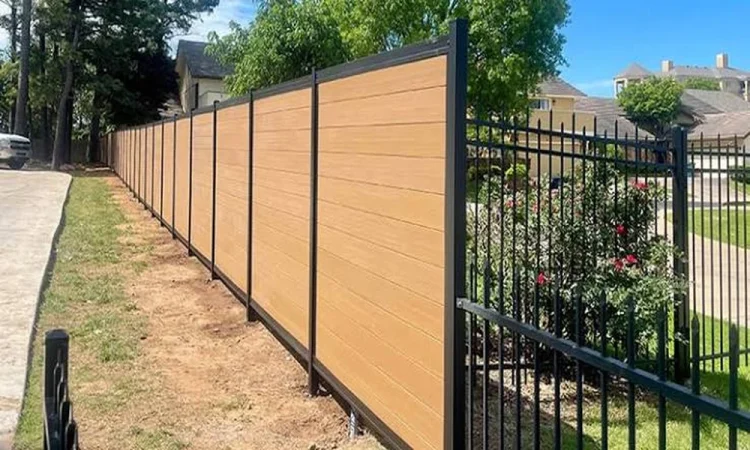
Owners comparing options can look at the lineup from Petrified Fence Boise services. The company offers concrete, hybrid, and rail fences, with its concrete and hybrid products built in-house. Its concrete fences carry a wind guarantee of up to 115 mph. The sections below cover how the other common materials behave here.
How Boise’s Sun and Dry Air Affect Wood Fences
Wood reacts to moisture and sunlight more than to heat alone. The Forest Products Laboratory explains that repeated changes in surface moisture create stresses that cause warping, cupping, and face checking. Ultraviolet light breaks down the surface layer, and windblown particles can add a sandblasting effect. Boise’s dry summer air can lower the moisture content of exposed boards, while repeated sprinkler exposure adds moisture and can contribute to uneven weathering.
The movement is small in each board and large across a fence. As a general estimate, softwood can change about 1 percent in width for every four-percentage-point change in moisture content. On a 5.5-inch picket, that works out to roughly 0.05 inch, although the actual change depends on the species and how the board was cut.
Finishes slow this cycle. Oregon State University’s forest products program lists finish reapplication intervals from several times a year to once every two years. Post choice also changes the outcome. The same program reports that western juniper fence posts can last 30 years or more. That durability comes from the heartwood; sapwood has less resistance to decay, and long juniper boards can still warp.
Vinyl in Heat and Cold
Vinyl responds to temperature more than to moisture. Ply Gem notes that PVC expands and contracts with temperature changes and becomes less flexible in cold weather. Winter cracking usually follows an impact, such as a snowblower, a plow, or falling ice. Some vinyl fence systems use metal reinforcement in posts or rails. Check the manufacturer’s specifications to see which components are reinforced and what loads the system is designed to handle.
The movement can be estimated using published thermal expansion coefficients, although actual fence movement depends on the product formulation, color, sun exposure, and installation. Using a 69°F temperature difference as an example, a 100-foot run would expand by approximately:
- Steel moves about 0.5 inch.
- Aluminum moves about 1 inch.
- Vinyl moves about 2.7 to 3.3 inches.
Larger temperature differences can increase the movement, so the manufacturer’s installation instructions should specify the required clearance inside rails and brackets. If the installation does not allow enough room for seasonal movement, temperature changes can cause panels to shift, buckle, or pull away from their connections. Cold weather brings its own risk during installation, because cold vinyl is more brittle and can crack when forced into place.
Concrete and Freeze-Thaw Cycles
Concrete avoids rot and sun-driven graying. Its cold-weather performance depends on the mix. An Iowa State study for the Iowa Department of Transportation found good freeze-thaw resistance in mixes with air content of 6 percent or more, and poor resistance in mixes without an air-entraining admixture. Boise’s freezing winters make concrete durability an important question. Ask the supplier for the panel’s freeze-thaw test results and mix specifications, including whether an air-entraining admixture is used. Air content alone does not establish how a finished panel will perform.
Hybrid designs combine concrete with other materials, so the second material still follows the rules above.
Questions to Ask Before Choosing a Fence
Three questions help compare quotes from any contractor. Ask what expansion allowance the system leaves in the rails and brackets. Ask how often the finish needs renewing and what that costs. Ask whether the panels have been tested for freeze-thaw resistance and request the test method and results. Read the warranty as well. One vinyl warranty states that movement within rails, panels, or pickets from temperature changes is normal and does not count as a manufacturing defect.
Matching the Material to Boise
The numbers point to a clear rule for each material. Wood works for owners who will commit to a recoating schedule. Vinyl works when the installer leaves room for movement and handles cold panels with care. Concrete works when the mix is air-entrained. Boise’s 69-degree swing, dry summer air, and hard freezes will test each choice every year, so get the answers in writing before the first post goes in.